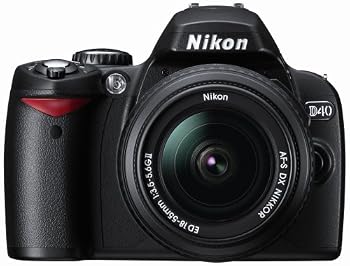
Digital Camera Resource has an in-depth review of the Nikon D40 Digital SLR camera. Here's just an extract. Their final verdict is "I strongly recommend trying the D40 and its competitors before you drop the big bucks on a D-SLR!"
Pros:
- Excellent photo quality; vivid colors and very low noise -- though see issues below
- Well built for its price
- Robust performance
- Large, bright, and sharp 2.5" LCD
- Shooting data well presented on the main LCD; settings can quickly be changed from the info screens
- Full manual controls
- Customizable menus and button
- Useful features for beginners like D-Lighting, red-eye removal, assist images, help system
- AF-assist lamp
- Redeye not a problem
- Above average battery life
- USB 2.0 High Speed support
- Purple fringing with kit lens; occasional blown highlights
- Limited selection of AF-S lenses means that many Nikkor lenses (mostly primes) will not support autofocus
- Grip could be larger
- No depth-of-field preview
- Included software doesn't allow for RAW image manipulation; Capture NX costs $150 more
- Would've been nice for assist images to be in full menu as well as quick menu
Find prices for the Nikon D40 Digital SLR.
Summary
With their new D40, Nikon has proven that you can make an entry-level digital SLR camera without cutting a lot of corners. There's a lot to like about this camera, from its compact size to its performance to its photo quality. For those ready to step up to the D-SLR world, the D40 is a fabulous way to do it.
The D40 is one of the most compact D-SLRs on the market, but it's not too small like the Canon Rebel XTi. Yeah, the grip is a little too small for my hands, but most people will find it to be acceptable (and better than the one on the Rebel). Build quality is also better than the Rebel, with higher grade plastics and an overall more solid feel. To cut down on the size of the camera, Nikon removed both the internal focus motor and LCD info display found on their other D-SLRs. The latter isn't a big deal, as Nikon did a nice job integrating shooting data onto the main LCD. You've got two views to choose from (I prefer the classic myself), and you can quickly change commonly used settings at the press of a button. The LCD itself is big, bright, and sharp. As for the lens motor issue, this really depends on how you plan to use the D40. If you'll be sticking to the kit lens and lenses like it, then you'll probably be fine. If you want throw on a 50 mm prime, then you'll probably want to get the Nikon D80 SLR instead, as it'll be manual focus only otherwise.
The D40 has a nice collection of point-and-shoot features, plus the full manual controls that you'd expect on a D-SLR. While the scene modes on the camera aren't necessarily new, the impressive in-camera help system is. When you use the "quick menu" to change settings, the camera shows "assist images" that tell you the situation for which you'd use that setting. There are also detailed help screens for every menu item -- even those confusing one in the custom settings menu. Add in the stuff in the Retouch menu like D-Lighting and redeye reduction and the D40 becomes the most user friendly D-SLR on the market. Power users don't need to worry, though -- the D40 has plenty of manual controls too. You've got the whole set of manual exposure controls, plus white balance and focus. The RAW (NEF) image format is supported, as well. The D40 lets you customize all the menus (showing only the options you want to see), and there's a custom button on the side of the camera as well. As far as expandability goes, the sky's the limit. You can choose from lenses, flashes, a wireless remote, and more.
Camera performance is superb. Flip the power switch and the D40 is ready to go. Focusing times were very good, and low light focusing was excellent thanks to a powerful AF-assist lamp. Naturally, shutter lag wasn't a problem, and shot-to-shot delays were minimal. The D40's continuous shooting mode isn't quite as fast as the one on the Rebel XTi, but it's still excellent, taking 6 RAW and a nearly infinite number of JPEGs at 2.5 frames/second. Battery life was above average, and the camera supports the USB 2.0 High Speed standard.
Photo quality was also very good. Nikon has tweaked the camera to produce what I'd call "consumer friendly" photos, with high color saturation and higher sharpness than on more expensive D-SLRs. Noise levels are very low, even at ISO 800. ISO 1600 is still usable, especially if you do some noise reduction in software. I'd probably save ISO 3200 for desperation only. I did run into a few photos with blown out highlights, though this is more a metering issue than anything. My main annoyance was the amount of purple fringing created by the kit lens -- more than I'd like to see. The camera had no redeye problem, but if it does come up, there's a removal tool built into the camera.
There are just a few negatives that I want to mention. First, while the camera supports the RAW image format, Nikon doesn't really give you any software to work with it, instead forcing you to get Capture NX or Photoshop. Second, while most D40 users won't care, there's no depth-of-field preview available. Lastly -- and this will sound like a petty complaint -- it would've been smart for Nikon to put those "assist images" in the full menu as well as the quick menu.
If you're ready to enter the world of digital SLRs, the Nikon D40 is a great way to do it. It offers a compact, truly portable body, great performance and photo quality, and a really user friendly interface for not a lot of dough. I can recommend the D40 without hesitation. I would say that the Canon Digital Rebel XTi is a somewhat more capable camera, but it also costs nearly $200 more. With that in mind, try both if you can, but don't think that you're giving anything up by getting the D40 -- you're not.
Read user reviews.
Find prices for the Nikon D40 Digital SLR.
You can read the rest of the review at Digital Camera Resource.

