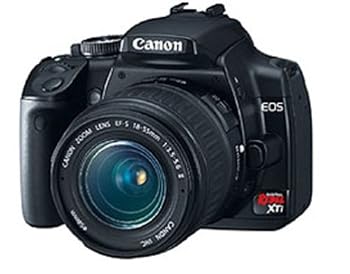
Jeff Keller at DC Resource has a review on the Canon Digital Rebel XTi SLR camera. Here's a roundup of his review.
Pros:
- Excellent photo quality
- Very low noise, even at high ISOs
- Dust reduction system
- Large 2.5" LCD display
- Full manual controls, including nice white balance controls
- Robust performance, especially in terms of continuous shooting
- Flash-based AF-assist lamp; very good low light focusing, even without using it
- Redeye not a problem
- Hot shoe for external flash
- Optional battery grip
- USB 2.0 High Speed support
- Capable RAW editor and remote camera control software included
Cons:
- Images on the soft side at default settings
- Small, hard to hold body; feels too "plasticky" in my opinion
- Below average battery life
- No spot metering
- No 2 second or custom self-timer (though mirror lockup is a workaround for the former)
Read user reviews
Find prices for the Canon Digital Rebel XTi SLR
Summary
While most owners of the Rebel XT probably won't run out to upgrade, the Canon Digital Rebel XTi (EOS-400D) is a most impressive entry-level digital SLR. It offers great photo quality and performance, plenty of features (most notably, a dust reduction system), a large LCD, and plenty of accessories. The main downside is its design: it's pretty small, not terribly easy to hold, and more "plasticky" than other D-SLRs. Despite that, the Rebel XTi earns my recommendation.
From most angles you won't be able to tell the Rebel XT and XTi apart -- the main differences can be found on the back of the camera. Canon has removed the LCD info display from the XT and instead put a larger 2.5" LCD that does double duty as an info display and a regular LCD. Some other design quirks about the XT weren't resolved on the XTi: I still think it's too small and difficult to hold comfortably. It also feels "plastic" compared to other entry-level cameras, especially the D80. Being a digital SLR, the Rebel XTi is expandable, with support for scores of EF and EF-S lenses, plus external flashes, remote controls, and a battery grip (to name just a few things).
The Rebel XTi has all the features you'd expect from a D-SLR, plus a few more. The XTi's resolution has been bumped up to 10 Megapixels, which is actually more than the "superior" EOS-30D -- I imagine a 40D can't be too far away. A more interested addition to the XTi is a dust reduction system, which attacks this annoyance from many angles (described earlier). In terms of shooting modes, you've got several scene modes, plus full manual exposure controls. While it won't let you set the color temperature, the XTi will let you do custom white balance, WB bracketing, and WB shift. Canon bundles a fairly complete software package with the camera, including a capable RAW editor and a remote capture program, both of which are options on the Nikon D80.
Camera performance was excellent in most respects. While the camera doesn't start up as quickly as some, it's due to the dust reduction system, and you can elect to skip this if you need to take a quick shot. The XTi focuses quickly, shutter lag isn't noticeable, and shot-to-shot speeds were snappy. The XTi can take 11 RAW or 33 Fine quality JPEGs in a row at just under 3 frames/second. About the only weak spot performance-wise is battery life, which is a bit below average.
Photo quality was excellent, especially with a decent lens on the camera (and the kit lens isn't one of those). The XTi took well-exposed, colorful images with very low noise levels, even at ISO 800. Like on all of Canon's D-SLRs, images are on the soft side straight out of the camera, and if you agree you can turn up the in-camera sharpening using the Picture Styles feature. Purple fringing levels varied depending on what lens I was using, but generally it wasn't a problem. Same goes for redeye -- there wasn't any to speak of.
There are just a few negatives that didn't fit in elsewhere. Like the other Rebel D-SLRs, there's no spot metering feature on the XTi. There isn't a custom or 2 second self-timer either, which is strange, since Canon's PowerShot cameras all have it. You can, however, use the mirror lockup option in the custom setting menu to accomplish this -- it's just a lot of work to do so.
And that's about it! Despite not being a big fan of its small size, I do like how the Rebel XTi performs, and it gets my highest recommendation.
Stuck between the Rebel XTi and the EOS-30D? If you need spot metering, manual color temperature control, and a better burst mode then you'll probably want to step up to the EOS-30D. If you have a Rebel XT and don't know what to do, I'd only suggest upgrading if you have had problems with dust getting on the sensor.
If you can't decide between the Rebel XTi and the Nikon D80 (and don't already own some of their respective lenses), that's a tougher question to answer. I much prefer the D80's design and build quality, but it is more expensive than the XTi. If you want that nicer body and a real LCD info display, then it may be worth spending more to get the D80. There's also the upcoming Pentax K10D, which offers a sealed, weatherproof body and image stabilization for around the same money. The bottom line is try as many of these cameras as you can, prioritize what features you require, and then make your own decision. I'm just here to help a little!
Read user reviewsFind prices for the Canon Digital Rebel XTi SLR
To read more, head over to the full review

